Top hunters of the insect world
Big eyes, fast brains, legs like a net and wings that each do their own thing.
Dragonflies have up to a 97% hunting success rate. Natural History Museum, London: Dragonflies, the ultimate hunters For comparison, lions succeed about 25% of the time and African wild dog packs about 85%. Natural History Museum, London: Dragonflies, the ultimate hunters
Eyes
A dragonfly can have as many as 30,000 lenses in each eye. Natural History Museum, London: Dragonflies, the ultimate hunters Their huge eyes give them near-360° vision. Natural History Museum, London: Dragonflies, the ultimate hunters
Their tiny brains can process about 200 images a second. Natural History Museum, London: Dragonflies, the ultimate hunters
Dragonflies can’t hear, so their eyes are vital. Natural History Museum, London: Dragonflies, the ultimate hunters
The catch
They ambush from behind and below, and use their long legs as a net. Natural History Museum, London: Dragonflies, the ultimate hunters
Adults mainly eat other flying insects, especially midges and mosquitoes. British Dragonfly Society: Frequently asked questions
Emperors rarely settle, and even eat their prey in flight. British Dragonfly Society: Emperor Dragonfly
Perchers and hawkers
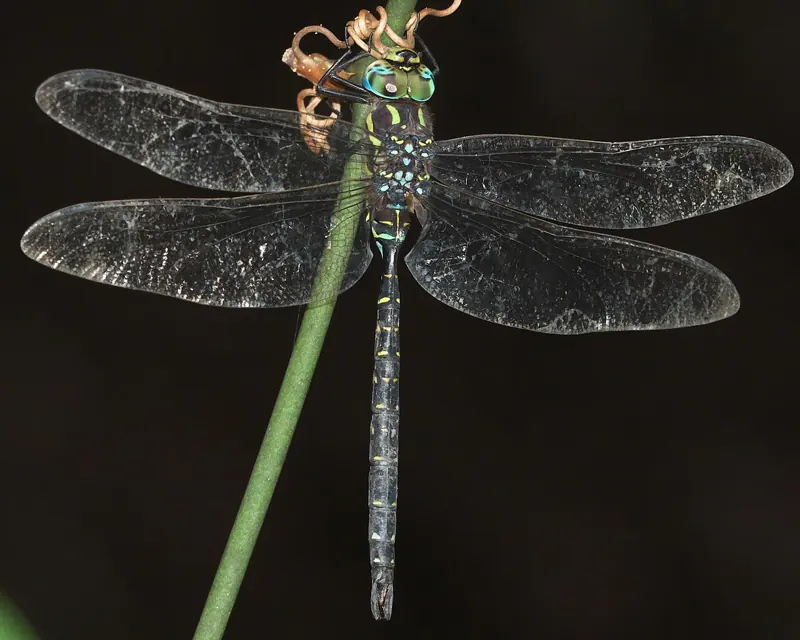
Hunters come in two kinds: perchers sit and wait, and hawkers patrol the air. Natural History Museum, London: Dragonflies, the ultimate hunters
Flying
They can control each of their four wings independently, so they can hover and fly in any direction. Natural History Museum, London (news, June 2018): Dragonfly wings could inspire new aeroplane flight control
The biggest hawkers can reach 10 to 15 metres a second, roughly 25 to 30 mph. British Dragonfly Society: Frequently asked questions
Migrant hawkers and four-spotted chasers sometimes gather in big swarms, usually where there is plenty of food. British Dragonfly Society: Frequently asked questions
Hunted too
Dragonflies have enemies too: birds such as wagtails and hobbies, spiders, frogs and bigger dragonflies. British Dragonfly Society: Frequently asked questions
And underwater
A larva has a hinged jaw (the labium) that shoots out in an instant to catch prey. British Dragonfly Society: Life cycle and biology Larvae eat insect larvae, worms, snails, tadpoles and even small fish. British Dragonfly Society: Life cycle and biology
Next: giants and tiddlers →